
How to Create the Perfect Wedding DJ Timeline [Step-by-Step]
 By Adam on Apr 2, 2026
 ![How to Create the Perfect Wedding DJ Timeline [Step-by-Step]](/blog/wedding-dj-timeline/cover.jpg)
Plan Your Next DJ Event with SongBoard
SongBoard makes DJ event planning simple. Your hosts pick the songs they want to hear, share the schedule, and more. So you can focus less on logistics and more on DJing.
If you DJ weddings, you already know: the timeline is the backbone of the whole night. Get it right, and everything flows. Get it wrong, and you're fielding frantic texts from the coordinator while the best man is mid-toast.
The problem is, most wedding timelines aren't built by the DJ. They're handed down from planners, or cobbled together by the couple from Pinterest templates. And that means key details a DJ actually needs are often missing.
This post walks through how to build a wedding DJ timeline that actually works for the person running the music: you.
Why DJs Need Their Own Timeline
Planners and venues think about timelines in terms of room flips, vendor meals, and sunset photos. DJs think about timelines in terms of energy, cues, and transitions.
Looking at hundreds of real wedding timelines from working DJs, many events run 12 to 15 detailed timeline entries, and the best ones have songs linked to each section. The average wedding timeline has about 7 timed sections, but DJs who plan in detail tend to break it into twice that many.
Your timeline should answer questions like:
- When do I need to be on mic?
- What song plays for each scheduled moment?
- When does the dance floor need to be packed?
- When can I take a break vs. when I need to be locked in?
- What moments are non-negotiable for the couple?
That's a fundamentally different document than "6:30 PM - Dinner Begins."
Wedding DJ Timeline Template
Here's a general structure that works for most traditional weddings. These time ranges reflect what real DJs actually schedule for their events—most weddings land somewhere in this window depending on venue details and ceremony start time.
DJ Arrival and Setup (2–3 hours before ceremony)
Most working DJs arrive between 1:00 PM and 3:00 PM, depending on ceremony time. This is when you unload, wire up, do a soundcheck, and confirm last-minute details with the coordinator. Real timelines show that DJs consistently schedule setup 2 to 3 hours before the ceremony begins.
Pre-Ceremony (30–60 min before)
This is background music territory. Guests are arriving and finding seats. Prelude music typically starts 30 minutes to an hour before the ceremony—most DJs schedule it between 3:00 PM and 4:30 PM depending on ceremony time.
- Play soft, ambient music that fits the couple's vibe
- Confirm mic levels for officiant and readers
- Double-check the processional and recessional song cues
DJ Tip: Have the processional songs loaded and cued at least 20 minutes before the ceremony starts. Last-minute song changes happen more than you'd think.
Ceremony
This is where precision matters most. Every song needs to land at the right second. Ceremonies typically begin between 3:30 PM and 5:00 PM and run 20 to 40 minutes. Some DJs break the ceremony into multiple timeline entries—parents processional, bridal party, bride entrance, vows, and recessional each get their own card.
Key music cues:
- Seating of parents/grandparents
- Bridal party entrance
- Bride/groom entrance (or both together)
- Readings or musical interludes
- Unity ceremony (sand, candle, etc.)
- Recessional
DJ Tip: Get a written cue list from the officiant or planner. Don't rely on hand signals alone. If you're using SongBoard, your couple can assign songs to each of these moments directly from their phone.
Cocktail Hour (60–90 min)
Cocktail hour is where you set the initial vibe. Music should be upbeat but conversational. Think lounge, not dance floor. In most real wedding timelines, cocktail hour kicks off right after the ceremony—usually around 5:00 PM to 6:00 PM—and runs 60 to 90 minutes.
This is the window where you finalize any last timeline changes with the coordinator and do your final soundcheck for the reception room.
- Mid-tempo mix with variety
- No announcements needed
- Keep volume at "background" level
Grand Entrance / Introductions
This is your first big moment on the mic. The energy shift from cocktail hour to "the party is starting" happens here. Most DJs schedule the grand entrance between 5:30 PM and 6:30 PM.
- Announce the wedding party (get pronunciation right)
- Announce the couple with their preferred introduction
- Transition directly into the first event (usually first dance or welcome toast)
DJ Tip: Always confirm the full introduction line with the couple ahead of time. "Mr. and Mrs." is not always what they want.
First Dance
One of the most emotional moments of the night. Real timelines show that the first dance most commonly happens right after the grand entrance or after dinner—anywhere from 6:00 PM to 8:00 PM depending on the flow.
- Confirm: full song, fade after chorus, or cut at a specific time?
- Does the couple want guests to join partway through?
- Is there a surprise choreographed element?
Parent Dances
Usually right after the first dance. Father-daughter and mother-son dances almost always happen back-to-back. Some couples add a mother-daughter or grandfather dance as well.
- Father-daughter dance
- Mother-son dance
- Any combined or additional family dances?
DJ Tip: Some couples want these back to back. Others want a break in between. Ask in advance.
Toasts and Speeches (15–30 min)
Toasts and speeches are one of the most consistently scheduled sections across real timelines. They usually land between 7:00 PM and 8:30 PM, often before or right after dinner.
- How many speakers?
- Are they using a wired or wireless mic?
- Any walk-up songs?
- Are you recording audio?
This is a good time to check that your mic levels are clean and your backup is working.
Dinner Service (45–60 min)
Background music only. Keep it smooth and unobtrusive. Dinner typically runs from about 6:00 PM to 7:30 PM, and many DJs create separate "dinner music" cards with their own curated playlists for this section.
- Light jazz, acoustic covers, or couple's playlist
- Announce buffet tables or courses if needed
- This is a good time to eat if the venue provided a vendor meal
Special Events
These vary by wedding but often include:
- Bouquet toss
- Garter toss
- Cake cutting
- Anniversary dance
- Shoe game or other group activities
Bouquet and garter tosses tend to happen during the dancing portion of the night rather than as separate standalone blocks. Cake cutting is one of the most consistently scheduled items across all wedding timelines—it typically happens between 7:15 PM and 8:00 PM. Some DJs also include vendor coordination cards for when the photographer or videographer wraps up, since that can affect lighting and crowd energy.
DJ Tip: Each of these needs a specific song cue and often a brief MC script. Have both ready.
Open Dancing (90–120 min)
This is where you earn your reputation. Open dancing usually starts between 8:00 PM and 8:30 PM.
- Start strong. The first 2–3 songs set the energy.
- Read the room. Adjust genres and tempo based on who's on the floor.
- Space out requests strategically.
- Save the couple's "must-play" tracks for peak moments.
Last Dance and Send-Off
Some DJs schedule a "wind down" period before the last dance—gradually reducing volume and tempo starting about 15 to 20 minutes before the end. Private last dances (just the couple on the floor) are increasingly popular. In many timelines, the last dance with guests happens around 9:45 PM, followed by a private last dance 5 to 10 minutes later, then a send-off or sparkler exit right at 10:00 PM.
- Announce last dance (confirm the song with the couple)
- Private last dance if requested
- Send-off song if there's a sparkler exit, glow stick tunnel, etc.
- Pack up once guests are out
How SongBoard Makes Timelines Easier
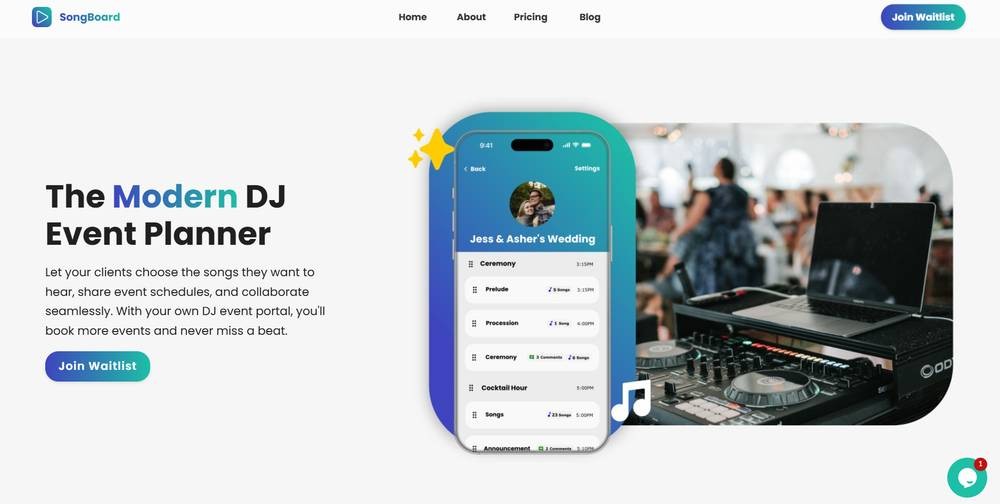
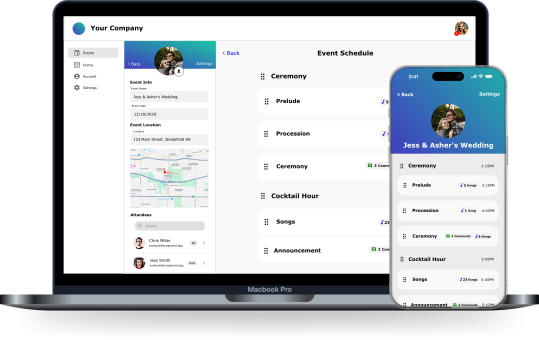
You can build this entire timeline inside SongBoard using Boards and Cards.
Each moment (ceremony, first dance, toasts) becomes a Card on the Board. Each Card can have:
- A specific time
- Assigned songs (pulled from Spotify, Apple Music, or YouTube)
- Notes for you and your team
- Questions for the couple to answer
- DJs-only visibility for private notes
Hundreds of real events planned through SongBoard have songs linked directly to timeline cards, so when a host adds a song request, it goes to the right moment—not a flat list you have to sort through later. DJs who plan in detail often break their events into 10 to 15 timed sections, and that level of granularity is where planning tools really pay off compared to spreadsheets or paper forms.
The couple and their planner can see and edit the timeline from their phone, so you're never chasing anyone for details.
And if you want to skip the manual setup entirely, SongBoard's Tempo AI can generate a full wedding timeline
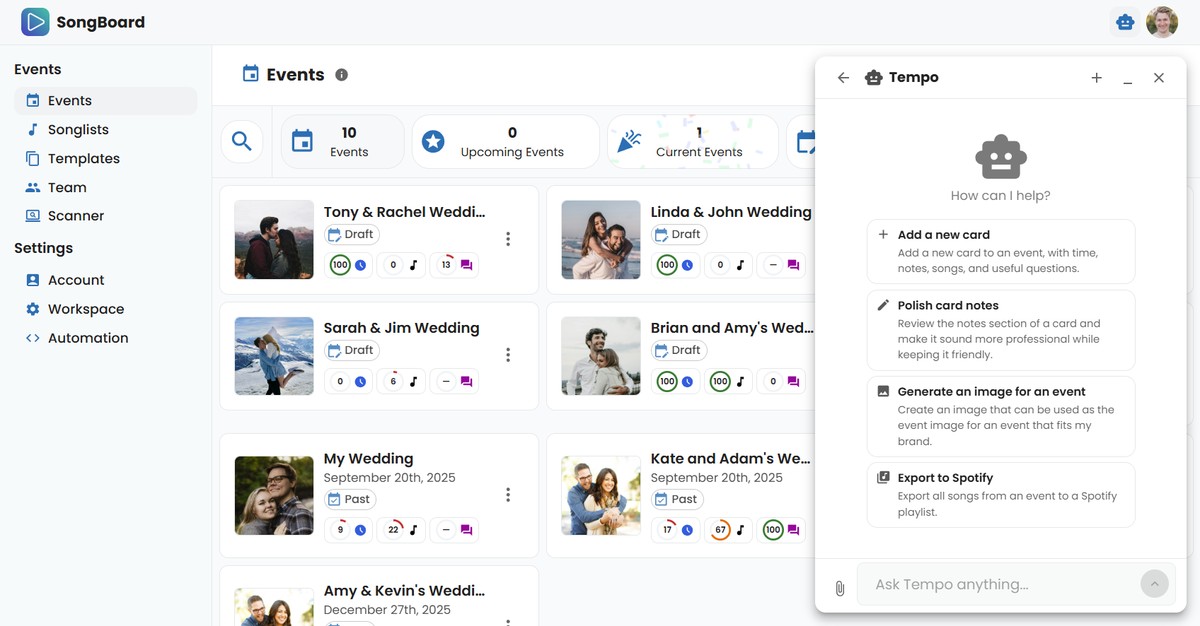
for you from scratch. Just tell it the basics and approve the plan. Tempo can even import timelines from other platforms like Vibo, mapping the timeline and songs into SongBoard automatically. You can learn more about how that works in our guide on how DJs use AI to plan events.
Common Timeline Mistakes DJs Make
Not padding transitions
Every moment takes longer than planned. Build in 5 minutes between major blocks. The coordinator will thank you. Real wedding timelines consistently show that ceremonies run 20 to 40 minutes, cocktail hours take the full 60 to 90 minutes, and dinner service often pushes past the hour mark.
Not confirming the "do not play" list
This is just as important as the must-play list. One wrong song during dinner can kill the vibe. Some DJs actually add a "do not play" card to their timeline so it stays visible throughout the night.
Relying on memory for cues
Write everything down. Even if you've DJed 200 weddings, this couple's timeline is unique. The DJs with the most detailed timelines break even the ceremony into multiple cards—one for each processional, one for vows, one for the recessional.
Not coordinating with the photographer
Photographers need to know when key moments are happening. Share your timeline with them. Experienced DJs include vendor coordination cards in their timelines—sunset photo windows, videographer wrap times, and photographer finish times—because those directly affect the energy flow.
Skipping the wind-down
Jumping from full dance energy to "goodnight" feels abrupt. Many experienced DJs schedule a 15 to 20 minute wind-down period where they gradually reduce volume and pace before the final last dance and send-off.
Conclusion
A good wedding DJ timeline isn't about being rigid. It's about knowing what's supposed to happen, when, and having the flexibility to adjust when things inevitably shift. Most weddings run about 6 hours from ceremony to send-off, but the best-planned events have every one of those hours accounted for.
Build your timeline around the music cues and energy flow, not just the schedule. Use SongBoard to keep it organized and shared with everyone who needs it. And always, always confirm the pronunciation of names.
Read the Latest From SongBoard
![Best Music Planning App for DJs: Event & Wedding DJs [2026]](/blog/best-music-planning-app-for-djs/thumbnail.jpg)
![How to Plan Music for Any Event: A DJ's Guide [2026]](/blog/event-music-planning/thumbnail.jpg)
![How to Start and Grow a Mobile DJ Business [2026 Guide]](/blog/mobile-dj-business-guide/thumbnail.jpg)
![How to DJ a Corporate Event: The Complete Guide [2026]](/blog/how-to-dj-a-corporate-event/thumbnail.jpg)
![How to Create the Perfect Wedding DJ Timeline [Step-by-Step]](/blog/wedding-dj-timeline/thumbnail.jpg)
![Best DJ Song Request Apps for 2026 [Ranked]](/blog/best-dj-song-request-apps/thumbnail.jpg)
Join Our Mail List 📃
Hear the latest from SongBoard, right as it happens. We'll send out an email for any major updates, and discount offers.We will never spam you or sell your information, and you can always opt-out at any time using the link at the bottom of any email.


© 2026 SongBoard. SongBoard is a trademark of SongBoard LLC. All rights reserved.