
How to Start and Grow a Mobile DJ Business [2026 Guide]
 By Adam on Apr 4, 2026
 ![How to Start and Grow a Mobile DJ Business [2026 Guide]](/blog/mobile-dj-business-guide/cover.jpg)
Plan Your Next DJ Event with SongBoard
SongBoard makes DJ event planning simple. Your hosts pick the songs they want to hear, share the schedule, and more. So you can focus less on logistics and more on DJing.
The term "mobile DJ" gets used loosely, but it really just means a DJ who brings their own gear to events. You're not a resident at a club. You're not a radio host. You show up, set up, perform, tear down, and drive home. Weddings, corporate parties, school dances, bar mitzvahs, company picnics, holiday galas—you do it all.
It's one of the most accessible ways to build a real business in the music industry. But going from "I own a controller and some speakers" to "I have a steady pipeline of bookings and a brand people recognize" takes more than good taste in music.
This post covers the practical stuff: how mobile DJs are building and growing their businesses in 2026, what tools actually help, and where most people get stuck.
What Makes a Mobile DJ Business Different
Mobile DJing is a service business, not a performance career. Your clients are hiring you to solve a problem: make this event feel right. That means music, yes, but also logistics, communication, professionalism, and reliability.
The DJs who grow the fastest aren't necessarily the best mixers. They're the ones who:
- Respond to inquiries quickly
- Send clear, professional proposals
- Communicate well throughout the planning process
- Show up prepared and on time
- Follow up afterward
If you nail those five things, you'll outperform 80% of the mobile DJs in your market.
Picking Your Niche (or Not)
A lot of advice says you should niche down immediately. Weddings only. Corporate only. Schools only. And eventually, that's smart. But when you're getting started, take whatever gigs come your way. Every event type teaches you something different.
That said, here's what the main niches look like in terms of effort and pay:
Weddings
Highest pay, highest effort. Wedding couples are emotionally invested and expect a lot of planning time. Average rates range from $1,000 to $2,500+ depending on your market. Weddings also generate the most referrals—one great wedding can lead to five more bookings.
Corporate events
Reliable pay, professional expectations. Corporate gigs typically pay $500 to $2,000+ and involve working with event coordinators rather than the end audience. These clients value punctuality and professionalism above everything.
School dances and parties
Lower pay, lower complexity. School dances pay less ($200–$600 typically) but they're great for building experience and word-of-mouth in your local community. Plus, the crowd is usually easy to please.
Private parties
Variable pay, variable effort. Birthday parties, anniversaries, holiday parties—these range widely. Some are straightforward background music gigs, others are full production events with lighting and MC work.
Equipment: Start Lean, Upgrade Smart
You don't need $10,000 in gear to start. You need:
- A controller (Pioneer DDJ-400 or DDJ-FLX4 are solid entry points)
- A pair of powered speakers (JBL EON, QSC K-series, or EV ELX are popular choices)
- A good pair of headphones (Sennheiser HD 25 or Pioneer HDJ-X5)
- A mic (wired Shure SM58 to start, wireless later)
- Cables, a stand, and a folding table
- A laptop with DJ software (Serato DJ Lite is free)
You can start with under $1,500 if you shop smart. Upgrade as you book more gigs and know what you actually need.
What to upgrade first
- Speakers. Better speakers = better sound = better reviews. This is the single best investment once you're serious.
- Wireless mic. For weddings and any event where you're MC-ing, wireless is essential.
- Subwoofer. For dance-heavy events, a 12" or 15" sub changes the energy on the floor.
- Lighting. Even basic uplighting or a couple of moving heads makes a huge difference in how professional your setup looks.
Getting Your First Clients
This is the hardest part. You have no reviews, no portfolio, and no referral network yet. Here's what works:
Do a few free or discounted gigs
Offer to DJ a friend's birthday, a local nonprofit event, or a community gathering. Treat it like a real gig. Set up professionally, play a great set, and get photos and testimonials.
Create a simple website
You don't need anything fancy. A one-page site with:
- Who you are
- What events you do
- Photos from real gigs
- A contact form
- Your pricing (or "request a quote")
Get on Google Business Profile
This is free and it's where a lot of local DJ searches happen. Set up your profile, add photos, and ask happy clients to leave Google reviews. Five good reviews can change your booking rate dramatically.
Use social media for proof, not just promotion
Post videos of your setups, clips of packed dance floors, and behind-the-scenes content. People hire DJs they can see in action. Instagram Reels and TikTok are surprisingly effective for local DJ marketing.
Network with vendors
Wedding planners, venue managers, photographers, and caterers all get asked "do you know a good DJ?" Being on their referral list is one of the most consistent lead sources in the industry. Meet them, be easy to work with, and they'll send clients your way.
Pricing Your Services
Pricing is one of the most stressful parts of starting a mobile DJ business, because you're essentially putting a number on your time and expertise with no industry standard.
Factors that affect pricing
- Your market. A DJ in New York charges more than a DJ in a small Midwest town.
- The event type. Weddings command higher rates than birthday parties.
- Hours of service. Most DJs quote a base rate for 4–5 hours, then charge per additional hour.
- Equipment provided. Lighting, extra speakers, and production add-ons justify higher pricing.
- Experience and reviews. As your reputation grows, your rates grow with it.
Starting rates
If you're brand new with no reviews, starting around $300–$500 for smaller events and $800–$1,200 for weddings is reasonable in most markets. Once you've built a portfolio and have consistent reviews, you can raise rates.
Don't compete on price
The DJs charging $200 for a wedding are not your competition. They're a different market entirely. Compete on professionalism, planning tools, and the client experience—that's what SongBoard helps with.
The Software That Actually Matters
You need two categories of software to run a mobile DJ business: performance software and planning software.
Performance software
This is your DJ software—Serato, Rekordbox, VirtualDJ, or Traktor. Pick one, learn it well, and build your library inside it.
Planning software
This is where a lot of mobile DJs fall behind. They use a mix of spreadsheets, text messages, email threads, and notes apps to manage events. It works for one or two gigs a month, but it falls apart fast.
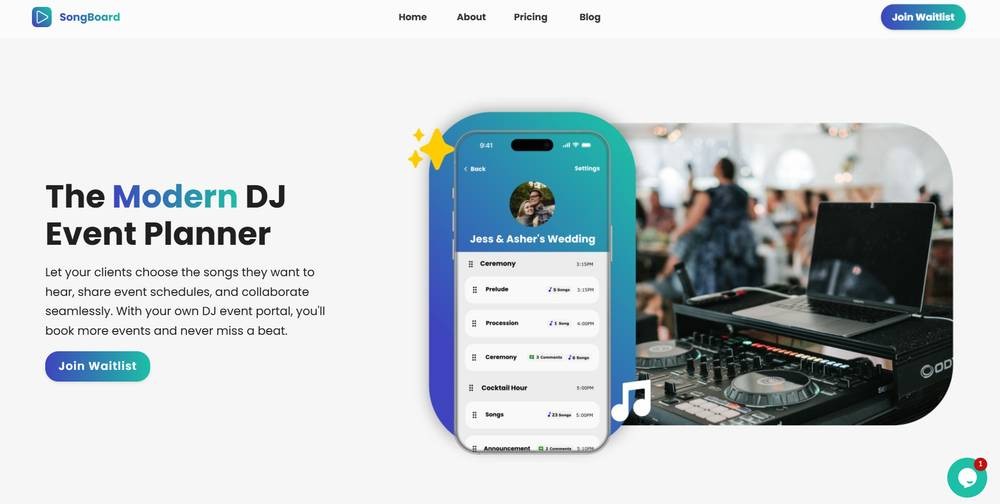
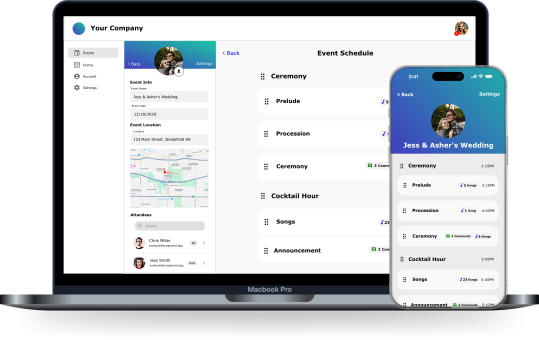
SongBoard is built specifically for event DJs. You create a shared portal for each event where your client can see the timeline, add song requests, answer planning questions, and leave comments. Everything is in one place instead of scattered across five apps.
Real wedding events planned through SongBoard average about 7 timed timeline sections, with the most detailed ones reaching 12 to 15 cards covering every moment from DJ setup to the final send-off. Hundreds of events have songs linked directly to timeline cards, so every request is tied to the moment it belongs to—not sitting in a flat list you have to sort through later.
For mobile DJs doing multiple events per week, this kind of tool saves hours and prevents the "wait, what song did they want for the first dance?" moments.
If you're running a multi-op company with several DJs, the team features let every DJ see their assigned events and stay coordinated without constant group chat messages.
Building Your Brand
Your name matters
Pick a name that's professional and easy to remember. Avoid names that are too clever or too generic. "DJ Mike" is fine for a personal brand. "Elevated Sound Entertainment" works for a company brand. Just make sure the domain is available.
Consistency across platforms
Use the same logo, colors, and tone everywhere: your website, social media, business cards, and event portal. When a potential client looks you up, everything should feel cohesive.
Client experience is your brand
More than any logo or website, what people remember is how working with you felt. Were you responsive? Were you organized? Was the portal easy to use? Did you follow up? That experience IS your brand, especially in an industry driven by referrals.
Scaling from Solo to Multi-Op
At some point, you'll have more inquiries than you can handle alone. That's a good problem. You have two choices:
Refer the overflow
Refer gigs you can't take to other DJs and ask for a referral fee. This keeps things simple while maintaining relationships with clients who might come back to you later.
Hire DJs and grow
This is the multi-op path. You build a roster of DJs who perform under your brand. You handle bookings, planning, and client communication. They show up and DJ.
This is where the right tools become essential. You can't manage four DJs across eight events a weekend with text messages. You need a system where every DJ can see their event details, the client's preferences, the timeline, and the song requests.
SongBoard's team features are built for exactly this. Each DJ on your team can access their assigned events through SongBoard, with all the planning details already organized. Clients interact with one professional portal regardless of which DJ is assigned.
Common Mistakes Mobile DJs Make
Not having a contract
Always have a contract. It protects you and the client. Cover the date, time, payment terms, cancellation policy, and equipment provided. There are plenty of DJ contract templates online.
Underestimating setup time
Always arrive earlier than you think you need to. Traffic, parking issues, elevator access, and unfamiliar venues can all eat time. For a standard setup, arrive at least 90 minutes before the event.
Ignoring the business side
A lot of DJs are great behind the decks but terrible at invoicing, follow-ups, and lead management. The business side isn't optional—it's what keeps the lights on.
Not asking for reviews
Every event should end with a follow-up email thanking the client and gently asking for a review. Google and WeddingWire reviews are gold for mobile DJs.
Conclusion
Your mobile DJ business grows the way any service business grows: by being easy to work with, delivering consistently, and building a reputation that sells itself through referrals.
Start lean, take every gig as a learning opportunity, invest in the right tools early, and treat every client like they're your most important one. The gear and the music matter, but the business side is what turns gigs into a career.
Read the Latest From SongBoard
![Best Music Planning App for DJs: Event & Wedding DJs [2026]](/blog/best-music-planning-app-for-djs/thumbnail.jpg)
![How to Plan Music for Any Event: A DJ's Guide [2026]](/blog/event-music-planning/thumbnail.jpg)
![How to Start and Grow a Mobile DJ Business [2026 Guide]](/blog/mobile-dj-business-guide/thumbnail.jpg)
![How to DJ a Corporate Event: The Complete Guide [2026]](/blog/how-to-dj-a-corporate-event/thumbnail.jpg)
![How to Create the Perfect Wedding DJ Timeline [Step-by-Step]](/blog/wedding-dj-timeline/thumbnail.jpg)
![Best DJ Song Request Apps for 2026 [Ranked]](/blog/best-dj-song-request-apps/thumbnail.jpg)
Join Our Mail List 📃
Hear the latest from SongBoard, right as it happens. We'll send out an email for any major updates, and discount offers.We will never spam you or sell your information, and you can always opt-out at any time using the link at the bottom of any email.


© 2026 SongBoard. SongBoard is a trademark of SongBoard LLC. All rights reserved.