
How to DJ a Corporate Event: The Complete Guide [2026]
 By Adam on Apr 3, 2026
 ![How to DJ a Corporate Event: The Complete Guide [2026]](/blog/how-to-dj-a-corporate-event/cover.jpg)
Plan Your Next DJ Event with SongBoard
SongBoard makes DJ event planning simple. Your hosts pick the songs they want to hear, share the schedule, and more. So you can focus less on logistics and more on DJing.
Corporate events are a different animal than weddings or house parties. The stakes are higher, the audience is harder to read, and the person who booked you isn't always the person making decisions in the room.
But for mobile DJs and event professionals who figure out the corporate circuit, it's one of the most reliable and well-paying segments out there. Private companies, nonprofits, universities, and government agencies all hire DJs for everything from holiday parties to product launches to employee appreciation events.
This guide covers how to DJ a corporate event the right way, from the first planning call to the last song.
What Makes Corporate Events Different
At a wedding, people are emotionally invested. At a corporate event, most attendees didn't choose to be there. That changes everything about your approach.
The client isn't the crowd
The person who hired you is usually an event coordinator, an HR director, or an executive assistant. They have a vision (or a committee's vision) for the night. Your job is to execute that vision, not impose your own.
That means asking the right questions early:
- What's the goal of the event? (Team building? Celebration? Client entertainment?)
- What's the dress code? (This tells you a lot about the energy level they expect.)
- Are there speeches, awards, or presentations?
- What's the age range and general vibe of the attendees?
- Is there a theme?
The music is more conservative
This isn't the time to test out deep cuts or build a set with long transitions. Corporate crowds want familiar, inoffensive, varied music. Think crowd-pleasers across decades and genres.
A good rule: if a song would make someone in a mixed-age office uncomfortable, skip it. Clean edits are essential.
The timeline is rigid
Corporate events run on a schedule. Dinner at 7:00, CEO speech at 7:45, awards at 8:15, open dancing at 9:00. You don't get to improvise the flow the way you would at a wedding reception. Real corporate timelines tend to be more compressed than weddings—often moving from networking to dinner to awards to dancing in a tighter window.
Get the timeline in writing. Confirm it with the coordinator the week of. And have it visible while you're performing.
Planning the Event
The discovery call
Most corporate clients will want a call (not just a form). Come prepared with questions that show you've done this before:
- How many attendees are expected?
- What's the venue layout? (Ballroom? Conference center? Rooftop?)
- Is there a sound system in the venue, or are you bringing everything?
- Will there be a podium or stage?
- Are there any AV requirements beyond music? (Slideshow, video playback, corporate logo on screens?)
- Is there a budget for lighting or uplighting?
Building the timeline
Corporate timelines usually look something like this. Real corporate event data shows that DJs typically set up 1 to 2 hours before guests arrive, and the overall structure follows a networking-to-dinner-to-program-to-dancing flow:
DJ Setup (1–2 hours before event)
- Arrive early, confirm AV setup, soundcheck
- Coordinate with venue staff and event coordinator
Pre-event / Networking (30–60 min)
- Background music: lounge, light jazz, downtempo
- Volume should allow conversation
Dinner (45–60 min)
- Same energy as pre-event, maybe slightly more upbeat
- Transition genres smoothly
- Canapé service events may have a more casual mingle-and-eat format rather than sit-down
Program / Speeches / Awards (15–45 min)
- Music beds under award walks (short, punchy tracks)
- Mic management is critical here
- Have walk-up music cued if they want it
Dancing / Social hour (60–120 min)
- Build energy gradually
- Start with recognizable hits from the 2000s–2020s
- Mix in classics if the crowd responds
- Corporate dance floors typically warm up slower than weddings, so don't panic if it takes a few songs
Send-off
- One final high-energy track, then a smooth wind-down
- Thank the host over the mic if they've asked you to
- Corporate events frequently run until 11:00 PM or 11:30 PM
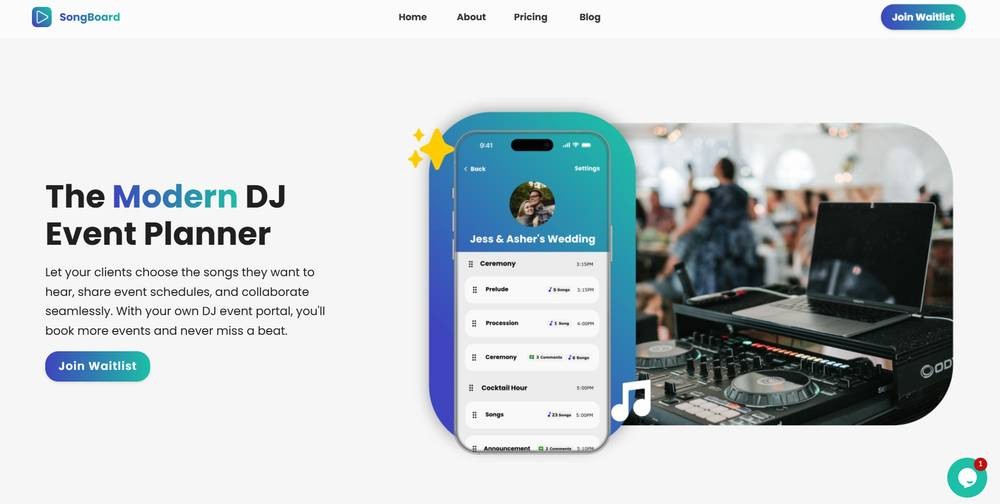
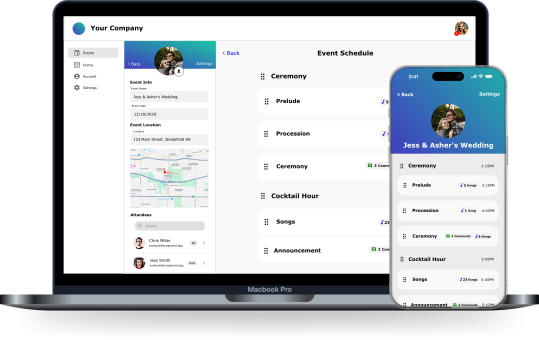
If you use SongBoard, you can build this whole timeline as a Board with Cards for each block. The event coordinator can see it, leave comments, and assign songs to specific moments. That kind of visibility goes a long way with corporate clients who are used to project management tools.
Music Selection for Corporate Events
The biggest mistake DJs make at corporate events is treating the dance floor the same way they would at a wedding or club. Corporate crowds are self-conscious. People are around coworkers and bosses. The music needs to remove barriers, not create them.
What works
- Motown and classic soul: Can't go wrong. "September," "Superstition," "Signed Sealed Delivered."
- Pop hits from the last 20 years: Think Bruno Mars, Justin Timberlake, Dua Lipa, Beyoncé.
- Throwback hip-hop and R&B (clean): "Yeah!" by Usher, "In Da Club" (clean edit), "Crazy in Love."
- Classic rock staples: "Don't Stop Believin'," "Livin' on a Prayer" — especially later in the night.
- Current pop: Whatever is charting, as long as it's clean.
What doesn't work
- Anything with explicit lyrics (even if the crowd looks young)
- Heavy EDM builds and drops (too aggressive for most corporate rooms)
- Super niche genres unless the client specifically asked for them
- Inside-joke songs that only part of the room gets
Reading a corporate room
Watch the edges of the dance floor. At corporate events, people tend to cluster in groups and wait for social permission to dance. Your job is to make the first 3–5 songs so universally appealing that a few groups start moving. Once that happens, others follow.
If nobody's moving after 10 minutes, don't panic. Drop the tempo slightly, play something everyone can sing along to, and give it time. Corporate dance floors warm up slower than wedding dance floors.
Working with Event Coordinators and Vendors
Corporate events usually have more vendor coordination than weddings. You might be working alongside:
- An AV company (they often control in-house sound systems)
- A lighting designer
- A photographer or videographer
- A catering team
- A stage manager or emcee
Get the AV contact early
If the venue has a built-in sound system, ask who manages it. Get that person's contact info and confirm:
- Can you plug into their system or do you need your own?
- Is there a sound check window?
- Are there volume limits? (Hotels often have decibel restrictions.)
Confirm the mic situation
Corporate events often need more mics than weddings. You might need:
- A podium mic for speeches
- A wireless handheld for awards
- A lavalier for a presenter who needs their hands free
Know this going in. Don't show up with one wireless mic and hope for the best.
Equipment Considerations
For most corporate gigs, you need more than just speakers and a controller.
Bring backup everything
Corporate clients have zero tolerance for technical issues. A speaker blowing at a wedding is stressful. A speaker blowing during the CEO's speech can end a business relationship.
Pack:
- Backup cables (XLR, 1/4", RCA, 3.5mm)
- A backup laptop or USB with your music
- A backup wireless mic with fresh batteries
- A power strip and extension cords (long ones)
- Gaffer tape for cable management
Dress the part
This is not a club gig. Wear what the attendees are wearing, or slightly above. If it's a gala, wear a suit. If it's a casual holiday party, business casual is fine. When in doubt, ask the coordinator.
How SongBoard Helps with Corporate Events
Corporate gigs involve more back-and-forth than most DJs expect. There's the coordinator, sometimes a committee, sometimes the person writing the check. Everyone has input.
SongBoard gives you a shared event portal where all of that communication lives in one place. The coordinator can see the timeline, approve songs, and add notes without sending you a chain of emails. You can lock cards so the final decisions are clear, and keep private notes that only your team sees.
For multi-op DJ companies doing a lot of corporate work, that kind of organization is the difference between looking like a vendor and looking like a partner.
Common Mistakes at Corporate Events
Playing too loud during dinner
The number one complaint at corporate events is volume. When people are networking or eating, the music should be audible but not dominating. If people have to raise their voices, turn it down.
Not confirming AV compatibility
Showing up and discovering the venue's system uses a different connector (or that you can't plug in at all) is a nightmare. Always confirm.
Ignoring the do-not-play list
Some corporate events explicitly ban certain genres, certain artists, or even certain songs. This isn't artistic censorship—it's liability management. Respect it.
Being too casual on the mic
Corporate MCs need a different tone than wedding MCs. Keep announcements short, professional, and warm. No catchphrases, no "let me see your hands." Just clear, confident delivery.
Not following up
Send a thank-you email within 48 hours. Corporate clients who had a good experience will book you again—and they'll refer you to other departments and partner companies. A short follow-up turns a one-time gig into a recurring relationship.
Conclusion
Corporate events are less emotional than weddings but more demanding in terms of precision, professionalism, and coordination. The DJs who do well in this space are the ones who treat every event like a business engagement, not just a party.
Plan thoroughly, communicate clearly, show up prepared, and follow up after. The corporate circuit rewards reliability more than anything else. And tools like SongBoard make it easier to look organized and professional from the first planning call to the last email.
Read the Latest From SongBoard
![Best Music Planning App for DJs: Event & Wedding DJs [2026]](/blog/best-music-planning-app-for-djs/thumbnail.jpg)
![How to Plan Music for Any Event: A DJ's Guide [2026]](/blog/event-music-planning/thumbnail.jpg)
![How to Start and Grow a Mobile DJ Business [2026 Guide]](/blog/mobile-dj-business-guide/thumbnail.jpg)
![How to DJ a Corporate Event: The Complete Guide [2026]](/blog/how-to-dj-a-corporate-event/thumbnail.jpg)
![How to Create the Perfect Wedding DJ Timeline [Step-by-Step]](/blog/wedding-dj-timeline/thumbnail.jpg)
![Best DJ Song Request Apps for 2026 [Ranked]](/blog/best-dj-song-request-apps/thumbnail.jpg)
Join Our Mail List 📃
Hear the latest from SongBoard, right as it happens. We'll send out an email for any major updates, and discount offers.We will never spam you or sell your information, and you can always opt-out at any time using the link at the bottom of any email.


© 2026 SongBoard. SongBoard is a trademark of SongBoard LLC. All rights reserved.